
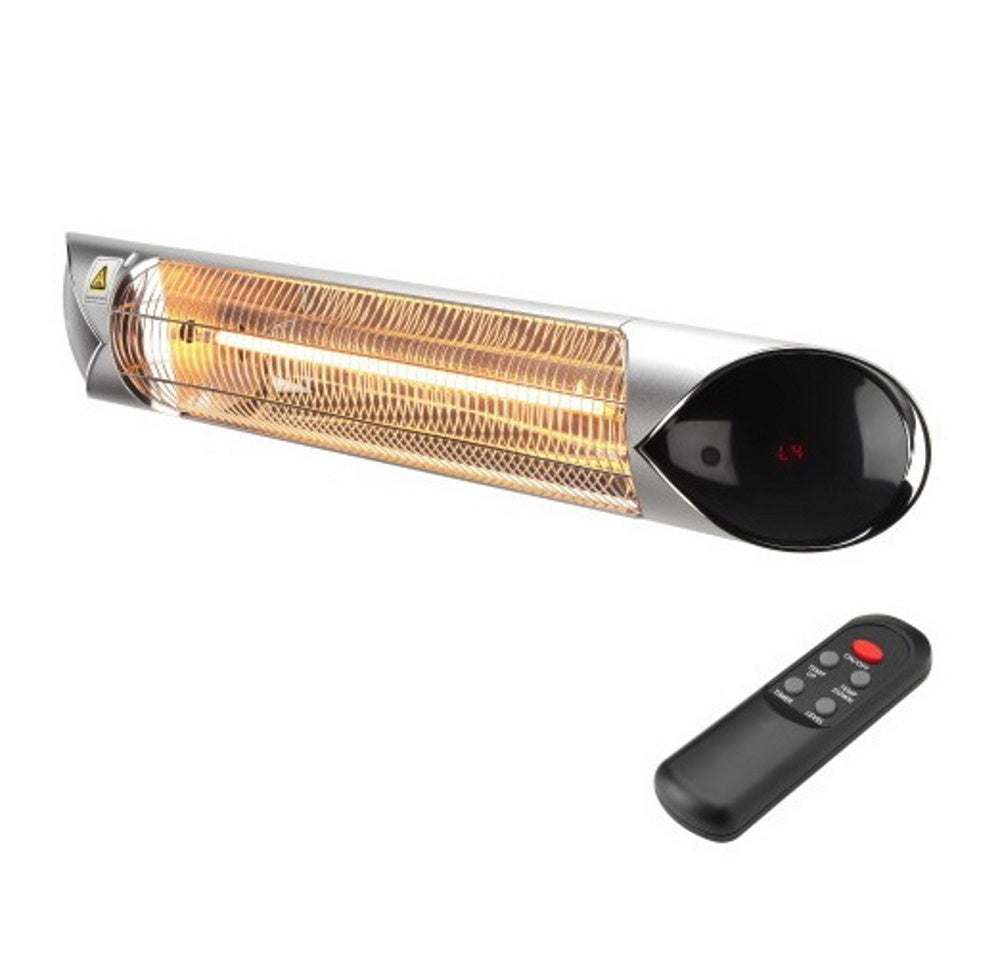
Infrared heating lamps use emitted radiation to heat people, not objects. But are they all the same, or are there differences between the various models on the market? We will try to understand the key features of these devices to choose the best solution for every need.
What do heating lamps do?
- Convert electrical energy into heat
- Heat only the area covered by the light beam
- Heat small or large areas, even outdoors
- Heat only when needed without pre-heating
- Heat individual workstations in always open environments
- Heat large areas like churches and warehouses with crossed beams
- Can be mounted on a stand for portability
What heating lamps do not do
- Do not move air
- Do not consume oxygen
- Do not have open flames
- Do not need to be refilled
- Heat does not rise upwards
- Are not suitable for heating environments subject to strong gusts of wind
- Are not designed to be activated by motion sensors
What types of lamps are there?
Infrared lamps are divided into three main categories based on the type of bulb used.
SHORT WAVE: Quartz or incandescent bulbs with gas inside the bulb. Our HLW and HLQ models have this type of bulb.
PROS
- Very intense heat
- Immediate ignition time
- Models with overlapping HLQ40 HLQ60 lamps can be installed at 4-6 meters
height covering large areas in warehouses and industrial buildings.
- Dimmable, meaning adjustable power in a block with the addition of a device
- Suitable for environments subject to breezes
- Suitable for environments with high foot traffic
- Some models with golden bulbs (like HLW and HLQ models with gold bulbs) reduce emitted light by 10%
CONS
- Relatively low energy-to-heat conversion ratio, from 50 to 80%
- Quite high brightness, not suitable for single workstations
or small work environments
- Not suitable for dimly lit environments
- Few models are capable of heating large environments.
- Bulb life is limited compared to medium and long waves.
- Generally do not have a remote control, requiring an electrical panel

MEDIUM WAVE: Carbon bulbs. Our BLAZE models have this type of bulb.
PROS
- Non-aggressive heat
- Immediate ignition time
- Advantageous energy-to-heat conversion ratio. The Blaze model converts 93% heat while the remaining 7% is light.
- Very long bulb life (for Blaze models, 10,000 hours)
- Adjustable power with 4-level remote control.
- Longer bulbs cover larger areas even when installed at heights between 2 and 3 meters
- A single bulb can reach up to 3kW
- Suitable for all work and restaurant environments where people stay for medium to long periods
CONS
- Not dimmable, each lamp must be controlled individually or with an optional wifi device (multi-infrared)
- Not suitable for particularly windy environments
- Not suitable for installations above 3 meters in height
- Cannot be activated with motion sensors or other types
- Not suitable for very dusty environments (like joinery workshops)
 LONG WAVE: Ceramic bulbs or similar materials.
PROS
- 100% energy conversion ratio, they do not emit light
- Suitable for environments where it is important not to have light sources
- Significant length, generally 1.5 meters
- Very long heating element life
- Heat from a radiant wall
CONS
- Ignition time 15-20 minutes
- Only for indoor environments. Very sensitive to drafts.
- High energy consumption from 2.6 kW up to 4.2 kW to achieve what a 2 kW-3 kW medium wave lamp provides
What characteristics determine lamp quality?
To assess whether a lamp is truly worth its price, some considerations regarding key elements need to be made
REAR SHIELDING: The quality of the projector is largely evident from the rear.
Lamps that emit light or excessive heat from the rear, in addition to risking fire, waste a lot of energy in the wrong direction.
The photo shows the back of a Blaze2000 Silver, fully shielded

AVERAGE BULB LIFE: In shortwave models, especially when installed with motion or presence sensors, bulb life is reduced from two years to much less.
Therefore, it is important to assess the availability of this component.
BULB TYPE: The quality, performance, and cost increase based on the type and length of the heating element. In order from least performing to most efficient
- Bulb with various gases (yellow tube, the bulb inside is not visible)
- Quartz bulb with glass in front
- Shielded quartz bulb (golden or with other darkening colors)
- Carbon bulbs
- Heating elements in ceramic or other radiant materials.
Which one to choose for your environment?
From our experience, HLW lamps or generally shortwave lamps are suitable for bars and ice cream shops that prioritize take-away, where customers usually don't stay long, so intense light is less bothersome. For private homes and venues with gazebos, pergolas, porches, terraces, and outdoor dining areas where users/customers remain seated for longer periods, it is better to opt for medium wave lamps such as Blaze. The low brightness and less aggressive heat are more suitable. The long-wave model, however, is suitable for ceiling installation in enclosed areas of hotels or convention centers with ceilings no higher than 3 meters.
WORKPLACES: A separate discussion is needed for workplaces. There are environments that remain open for the passage of forklifts or, in the case of tire shops, with continuous vehicle traffic.
In these cases, HLQ lamps or Blaze models work particularly well because they heat even large areas. For warehouses with very high ceilings, there are various approaches. The first is to heat individual workstations with 3kw BLAZE lamps installed on the side walls or possibly with 2.5KW Blaze lamps on a stand in central positions.
The second solution involves installation at variable heights from 4m (HLQ40) to 6m (HLQ60) of overlapping shortwave lamps on walls or support columns to cover wider areas.
These evaluations should still be made with a technician.
